
BritCham Chile addresses new legal and educational challenges to prevent violence and strengthen school coexistence
August 20 ,2026


August 20 ,2026
Experts from the legal, psychological and educational fields analysed the new requirements facing educational establishments in light of recent regulatory changes, stressing that legal compliance must be accompanied by prevention, community participation, due process and stronger relationships within schools.
Santiago, 19 August 2026. School coexistence cannot be addressed solely through disciplinary measures, nor can it be reduced to formal compliance with new legal obligations. This was one of the main messages to emerge from the online discussion “School Coexistence, Violence and New Legal Obligations: Implementing Law No. 20,536 and Law No. 21,809 in Educational Establishments”, organised by the Education Committee of the Chilean-British Chamber of Commerce (BritCham Chile).
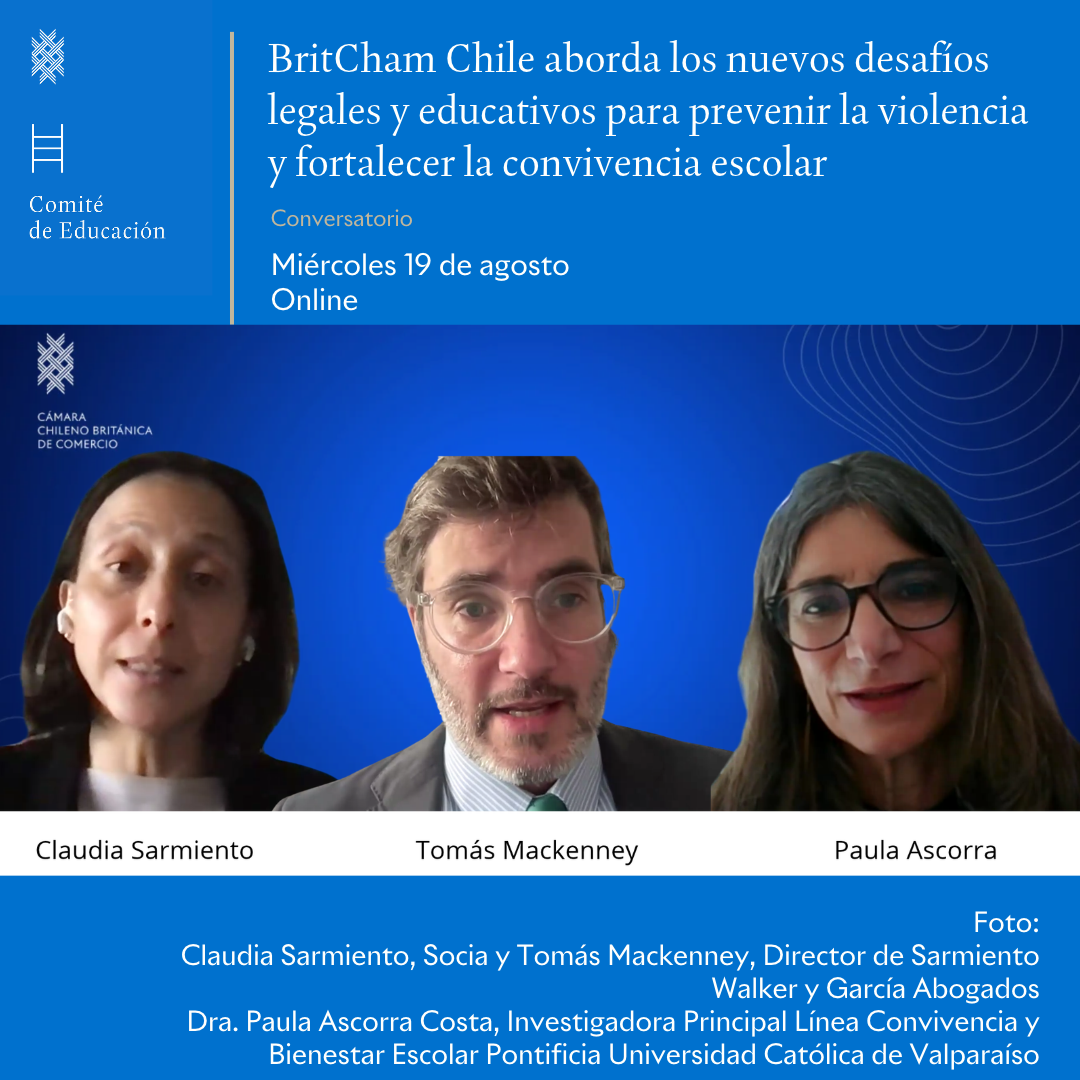
The event brought together Dr Paula Ascorra Costa, psychologist, Director of the School of Psychology and Full Professor at the Pontifical Catholic University of Valparaíso (PUCV), and Principal Researcher for the School Coexistence and Wellbeing Research Area; Claudia Sarmiento, lawyer and Partner at Sarmiento, Walker y García; and Tomás Mackenney, lawyer and Director at Sarmiento, Walker y García. The session was moderated by Claudia Parra, President of BritCham Chile’s Education Committee.
The discussion aimed to analyse the changes taking place in the regulatory framework governing school coexistence and the responsibilities placed on school administrators, leadership teams, school coexistence officers and educational communities. The conversation also incorporated the recently enacted Law No. 21,827, which introduces a stronger security focus and new powers for responding to situations of violence.
From reacting to violence to establishing genuine governance of school coexistence
Opening the event, Claudia Parra noted that school coexistence is currently one of the main challenges facing educational communities, in a context marked by conflict among students, aggression towards teachers and a deterioration in the school environment. This, she added, is compounded by a regulatory framework that establishes new responsibilities for school administrators, leadership teams and coexistence teams.
“School coexistence cannot be addressed exclusively as a disciplinary issue, nor solely as a legal obligation. The challenge is much broader. It involves reviewing and updating regulations and protocols, strengthening the capabilities of educational teams, developing preventive strategies and creating the conditions needed to build environments based on respect, inclusion, positive relationships and wellbeing,” Parra said.
From a legal perspective, Claudia Sarmiento explained that the recent changes require coexistence to be understood as a permanent institutional structure within schools rather than as a secondary responsibility. The legislation distributes duties among school administrators, headteachers, coexistence teams, coordinators and participatory bodies, while placing primary responsibility on the school administrator to ensure the conditions and resources required for effective implementation.
One of the most significant changes is precisely the strengthening of institutional governance of school coexistence, through plans that must establish objectives, targets, responsible persons and monitoring mechanisms. The framework also requires technical, pedagogical and administrative coordination, dissemination of obligations among different stakeholder groups, student participation and the involvement of families. Particular emphasis is also placed on mental health, identifying risk factors and suicide prevention, while promoting collaborative conflict management and mediation rather than immediate sanctions.
“The plan is no longer simply a calendar of activities; it is an instrument setting out objectives and targets that can be measured,” Sarmiento explained, stressing that implementation requires clearly identified responsibilities and coordination capable of designing, executing and evaluating the measures adopted.
Internal regulations and due process: a critical obligation for schools
The experts emphasised the need for educational establishments to review their Internal School Coexistence Regulations, ensuring that sanctionable conduct, procedures, protective measures and appeal mechanisms are clearly defined and known throughout the school community.
Sarmiento stressed that investigations into violence, harassment or discrimination must be conducted promptly, impartially and confidentially, while respecting the right of those involved to be heard. Disciplinary decisions must also be based on verifiable evidence and be proportionate to the seriousness of the conduct involved.
“The more structure there is, the more that structure works and is understood, the more effective it will be,” Sarmiento said, highlighting that protective measures, separation arrangements, access restrictions and other actions must be incorporated in advance into institutional policies so that they are not perceived as arbitrary.
She also underscored the importance of documenting the actions taken by schools and maintaining full traceability of procedures, particularly as decisions may subsequently be reviewed by the Superintendence of Education or the courts.
School safety: new powers, but with clear safeguards and limits
Tomás Mackenney focused particularly on the provisions of Law No. 21,827, explaining that, unlike the preventive and governance-based emphasis of Law No. 21,809, the newer legislation responds more directly to a logic of security, order and protection of the educational community.
Among the issues discussed were searches of belongings, measures in response to aggression by parents or guardians, access controls and duties to act in specific situations involving violence.
Mackenney was clear that several of these tools are powers available to schools rather than automatic obligations.
With regard to searches of schoolbags and other belongings, he explained that the legislation establishes both limits and safeguards. Searches may cover schoolbags, bags and certain personal effects, but do not authorise body searches or the use of force. Consent is required, as are authorised and trained staff, a written record of the procedure and appropriate privacy conditions. For such a measure to be applied, it must be incorporated into the school’s Internal Coexistence Regulations and communicated in advance to the educational community.
“These are powers, not obligations,” Mackenney stressed, noting that any application of these measures must remain within the framework established by law and by the school’s own internal policies.
He also explained that there are enhanced safeguards for students with disabilities, autism or other forms of neurodivergence, including prior support, emotional containment and appropriate care when certain measures are applied.
Paula Ascorra: “Place value on relationships”
From a psychological and educational perspective, Dr Paula Ascorra argued that effective violence prevention requires schools to go beyond protocols and procedures and strengthen the relationships that underpin educational communities.
“What I would say to the educational community — and I say this very seriously because I have worked in this area for many years — is: place value on relationships,” Ascorra said.
The academic explained that building meaningful relationships among students, teachers and families is an important protective factor and can allow many situations to be managed at an early stage, before they escalate into highly bureaucratic or judicialised processes.
On socio-emotional education, Ascorra distinguished between an approach centred on individual skills — such as recognising and naming emotions — and a broader community and collective perspective. In her view, working exclusively at the individual level is insufficient and must be complemented by strategies involving the wider school community.
She also stressed that any new policy needs to generate shared understanding and shared purpose. Measures imposed from the top down, without prior discussion with students, teachers and parents or guardians, can create resistance and undermine their effectiveness.
“To the extent that you build consensus and a shared understanding around the rule, it will have value,” she said, insisting on the importance of discussing and socialising decisions with the different groups that make up the educational community.
Prevention before intervention
Another major theme of the discussion was the need to shift resources and capabilities towards universal promotion and prevention, rather than concentrating them solely on individual intervention after a conflict has already occurred.
Ascorra proposed working through a “whole-school” model, allocating the greatest share of effort to universal promotion and prevention; a second level to work with groups presenting risk factors; and a smaller proportion to individual cases requiring specialised support or referral.
She also noted that schools cannot respond on their own to every issue affecting children and young people and that, in certain cases, they must coordinate with other bodies within the wider protection system.
A challenge that goes beyond regulatory compliance
The discussion highlighted that the new provisions require schools to strengthen two dimensions simultaneously: first, they must have clear, documented and legally sound procedures for responding to incidents of violence; and second, they must develop a preventive culture capable of intervening before conflicts escalate.
The coexistence of different legal frameworks — including those relating to school coexistence, safety, the rights of children and young people, inclusion and employment relations — also increases the need for coordination among school administrators, leadership teams, coexistence teams, teachers, psychosocial professionals and families.
BritCham Chile’s Education Committee emphasised that the central challenge will be to translate these legal obligations into effective institutional practice, ensuring that coexistence is not reduced to regulations and protocols alone.
The key conclusion of the discussion was clear: a safe school is not built solely by sanctioning violence. It requires prevention, trust, clear and well-understood rules, due process and, above all, stronger relationships capable of sustaining educational communities based on respect, inclusion and wellbeing.
The BritCham Chile Education Committee will continue to promote spaces for dialogue among the educational, academic and professional sectors in order to analyse the challenges facing the sector and generate practical tools that can contribute directly to the work of educational communities.


