
Changing the Game: Generative Artificial Intelligence in Today’s World
June 30 ,2025


June 30 ,2025
BritCham Chile brings together leaders from the public, private, and academic sectors to discuss the ethical, regulatory, and social challenges of AI
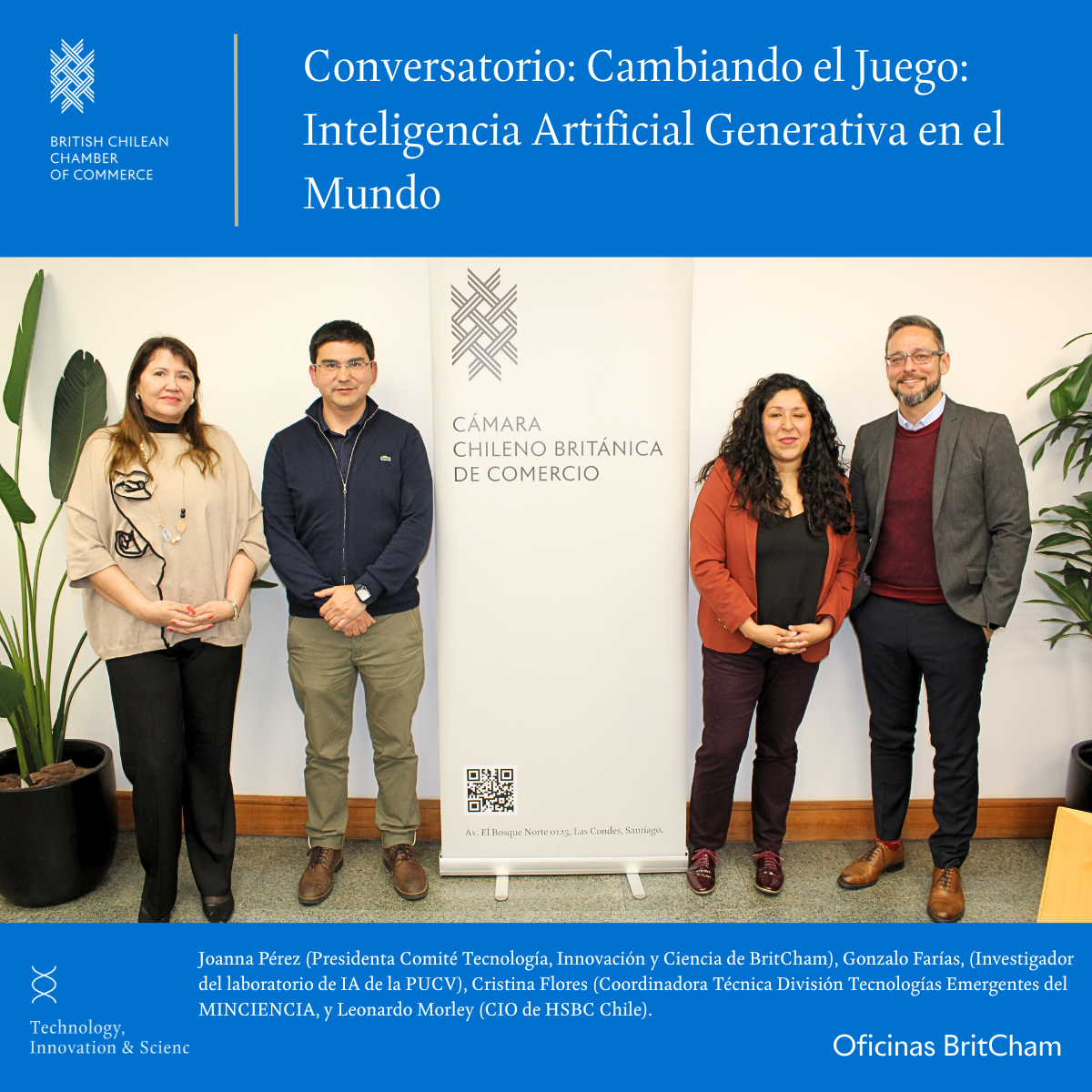
Santiago, June 25, 2025 – Against a backdrop of rapid technological advancement and a pressing need for regulatory frameworks, the British Chilean Chamber of Commerce (BritCham Chile), through its Committee on Technology, Innovation and Science (CTI), held the discussion panel “Changing the Game: Generative Artificial Intelligence in Today’s World.” The event took place at BritCham Chile’s offices in Las Condes and gathered representatives from the public, academic, and corporate spheres to reflect on the impact of Generative AI (GAI) on society, industry, and public policy.
The session was moderated by Joanna Pérez, President of the CTI Committee, who emphasized: “AI is no longer a futuristic concept—it is urgent and current. We have a duty to build a roadmap that enables ethical, inclusive, and strategic development for Chile.”
Cristina Flores, Technical Coordinator for Emerging Technologies at the Ministry of Science, Technology, Knowledge, and Innovation.
Dr. Gonzalo Farías, Director of the Artificial Intelligence Laboratory at Pontificia Universidad Católica de Valparaíso (PUCV).
Leonardo Morley, Chief Information Officer (CIO) of HSBC Chile.
The panel opened with a technical introduction by Cristina Flores, who defined Generative AI as a subdiscipline of AI that enables machines to emulate human cognitive abilities such as language, perception, and content creation. Flores stressed the importance of digital literacy: “We must democratize understanding of how machine learning models work and what their social implications are.”
Dr. Gonzalo Farías highlighted the quantum leap that AI has taken in recent years: “We now have systems capable of generating text, images, and videos that are indistinguishable from human content. This transforms industries but also challenges traditional regulatory frameworks.”
Leonardo Morley emphasized the practical impact of AI across sectors: “GAI is already part of everyday life—from graphic design to process automation. The key is to keep the human at the center of critical decision-making.”
Flores also presented the recent progress made in AI regulation. In May 2024, the Chilean government introduced a bill to establish a risk-based legal framework for AI that incorporates principles such as transparency, human oversight, and protection of fundamental rights. “AI is not neutral. It reflects human decisions. That’s why regulation is crucial,” she affirmed.
Dr. Farías added: “Legislation must be adaptable. This technology evolves in months, not years. What’s cutting-edge today may be outdated tomorrow.”
All three panelists agreed that one of the biggest challenges of GAI is algorithmic bias. They shared real-world examples of gender and racial bias in hiring algorithms and facial recognition systems. Flores emphasized: “There is no such thing as zero bias. But we can create models that identify and mitigate it through targeted training and transparency.”
They also addressed the importance of explainability in AI-driven decision-making and proposed that users should have the right to know how and why an AI system made a specific decision, especially in sensitive contexts such as hiring processes.
During the Q&A session, one of the key concerns raised by the audience was data security. Morley noted: “Using public AI platforms like ChatGPT for sensitive data is a major risk. At HSBC, we’ve developed private, internal AI models to ensure data confidentiality.”
The conversation also explored the environmental impact of AI. Farías detailed the high energy and water consumption of training large-scale models and called for sustainable alternatives such as renewable energy-powered data centers and quantum computing.
The event concluded with a call from BritCham to foster continued cross-sector dialogue and ethical AI literacy. As Joanna Pérez stated: “AI should not replace human judgment, but enhance it. Our challenge is to define how, when, and under what conditions it adds value.”
The full recording of the session and the participant survey are available on www.britcham.cl, in the Technology, Innovation and Science Committee section.


