
Open Finance and Fintech: Shaping the Future of Chile’s Financial Ecosystem
October 8 ,2025


October 8 ,2025
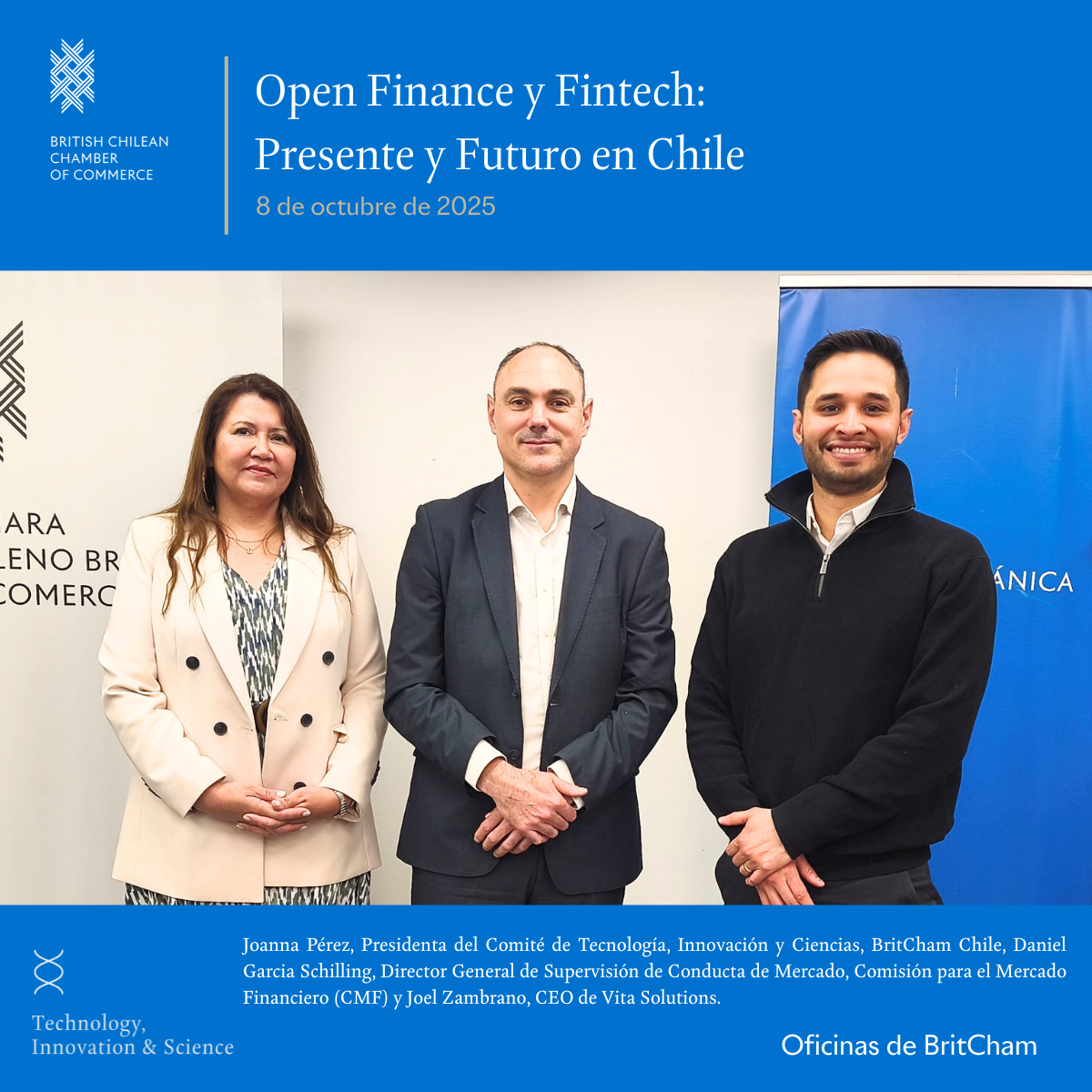
Santiago, Chile – 8 October 2025. The British Chilean Chamber of Commerce (BritCham Chile), through its Technology, Innovation and Science Committee, held an in-person conversation on “Open Finance and Fintech: Present and Future in Chile”, bringing together public and private sector representatives to discuss the regulatory, technological, and market evolution driving financial innovation in the country.
The session was moderated by Joanna Pérez, President of BritCham’s Technology, Innovation and Science Committee, and featured two leading voices in the field:
A New Financial Era Under the Fintech Law
Chile’s Fintech Law (Law 21.521) has positioned the country at the forefront of financial innovation in Latin America. The regulation establishes a robust framework for Open Finance, enabling users to share financial data securely through APIs and fostering transparency, competition, and inclusion.
Daniel García explained that over 130 entities are currently undergoing the registration process at the CMF as providers of financial services under the new regulatory standards. He emphasised the principles of proportionality and gradual implementation, recognising that not all actors have the same scale or risk exposure:
“This is not a simple process. Business models are complex, interconnected, and still evolving. We are defining clear regulatory boundaries so that all participants can operate with confidence,” García noted.
He also highlighted the CMF’s General Rule 514, which sets out minimum cybersecurity standards and defines the governance model for Open Finance implementation. “It is a profound change in how financial institutions and users interact, with data protection and transparency at its core,” he added.
From Self-Regulation to Global Standards
Representing the private sector, Joel Zambrano shared Vita Solutions’ experience transitioning from voluntary compliance to full adaptation under the new law.
“When we started in 2019, the ecosystem was still unregulated. We decided to adopt best international practices in risk management and AML before regulation existed,” Zambrano recalled.
He stressed that this proactive approach enabled a smooth transition to the new framework:
“The Fintech Law brings certainty. The challenge now is understanding new business models and ensuring that innovation translates into real benefits for consumers, particularly SMEs.”
Zambrano noted that Open Finance and digital payment rails have dramatically reduced transaction costs. “Six years ago, sending money abroad could cost up to 13%. Today, it’s less than 1%. That’s democratisation of financial access,” he said.
Challenges Ahead: Security, Transparency, and Education
During the Q&A, participants discussed critical issues such as data security, AML obligations, and the role of consumer education in mitigating risks associated with digital finance.
García pointed out that information security remains one of the CMF’s top priorities:
“A failure in security or custody standards has social and reputational costs. The Fintech Law introduces suitability requirements so that products are offered according to clients’ needs and risk profiles.”
Both speakers agreed that the success of the new regulatory environment will depend on a combination of institutional oversight, technological robustness, and financial literacy among users.
A Dialogue for the Future
Closing the session, Joanna Pérez praised the collaboration between regulators, industry players, and the Chamber’s network:
“Innovation can only thrive when regulation and entrepreneurship move in harmony. What we witnessed today was a constructive exchange between two worlds that must work together to ensure a safe, inclusive, and competitive financial ecosystem.”
The event is part of BritCham Chile’s 2025 Technology, Innovation and Science Committee series, which fosters dialogue on digital transformation, AI, cybersecurity, and emerging technologies impacting business and society.