
Synthetic Phonics: Foundations and Applications for Early English Learning
October 30 ,2025


October 30 ,2025
BritCham Chile – Education Committee Webinar Series
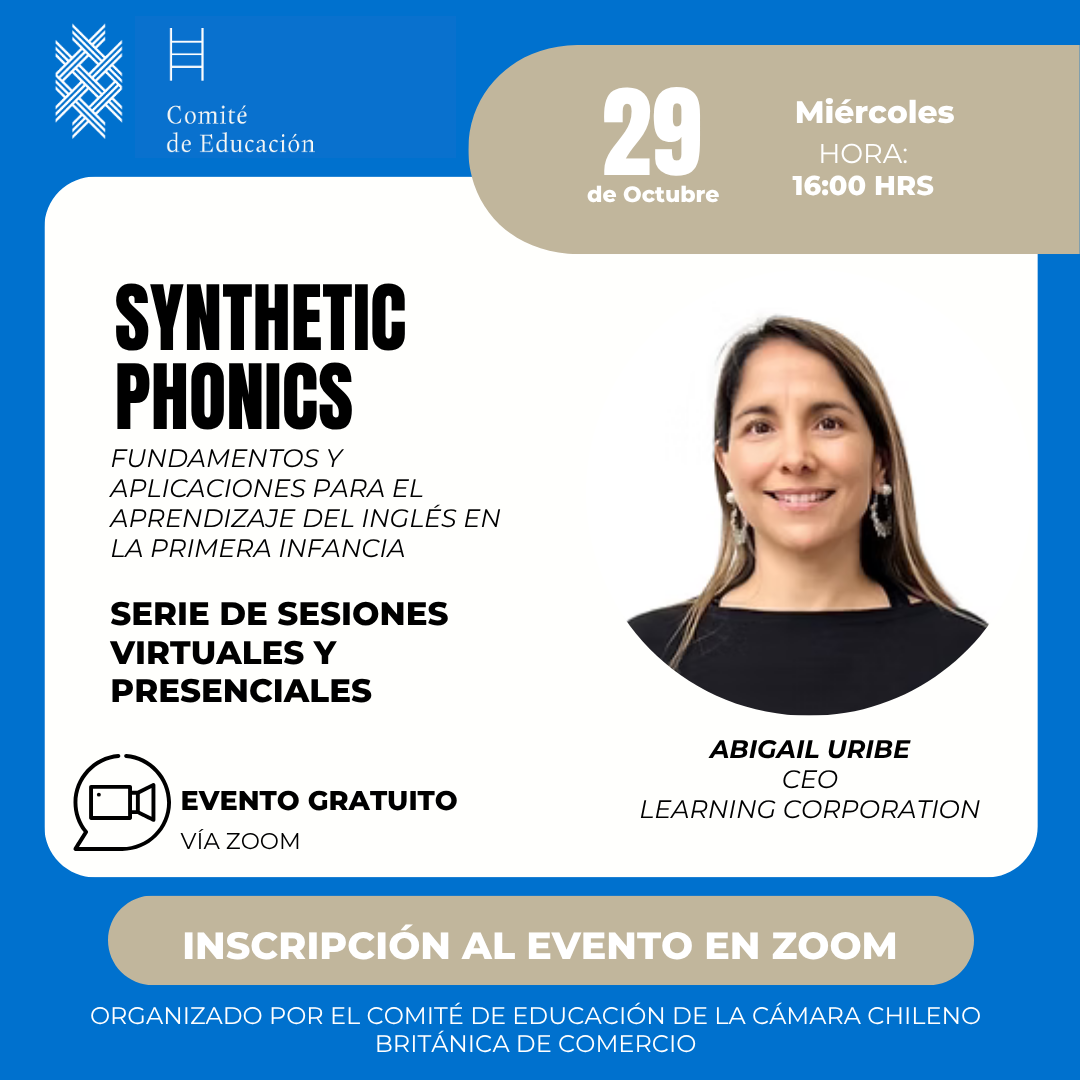
Santiago, 29 October 2025 — The Education Committee of the Chilean-British Chamber of Commerce (BritCham Chile) inaugurated its new educational webinar series with an inspiring session titled “Synthetic Phonics: Fundamentos y Aplicaciones para el Aprendizaje del Inglés en la Primera Infancia”.
The event was moderated by Dalinda Pérez-Álvarez, Director of the Office of the Americas at the University of Edinburgh and Chair of the BritCham Education Committee, who emphasised that this first session — delivered in Spanish — was designed “to give broader access to the many educators and parents interested in understanding this evidence-based method that is transforming early literacy teaching.”
The session’s keynote speaker, Abigail Uribe, a renowned pedagogue with over twenty-six years of experience in teaching English as a foreign language, delivered an insightful and practice-oriented presentation. Drawing on her expertise as Director of TISA, university academic, and methodology specialist, Uribe outlined the pedagogical foundations of Synthetic Phonics, an approach that systematically teaches the relationship between letters and sounds to strengthen both reading and writing from early childhood.
“This method was born as an educational and scientific response to the need for a structured, evidence-based way of teaching literacy,” Uribe explained. “After extensive research in the United Kingdom, Synthetic Phonics became public policy through the ‘Letters and Sounds’ programme in 2007 — a model that has since been adopted globally, including in bilingual and non-bilingual schools across Latin America.”
Uribe’s presentation guided attendees through the six structured phases of the Letters and Sounds programme — from phonological awareness to reading fluency — illustrating how these stages can be adapted to diverse educational contexts. She highlighted the importance of early exposure to sounds, rhythm, and rhyme, as well as the integration of playful and sensory-based strategies:
“Every child has the ability to read and write from an early age — they only need us to believe in them and provide the right environment for exploration and confidence.”
The thematic moderation was conducted by Pilar Zárate, Senior Academic Consultant at Cambridge and expert in applied neuroscience, who facilitated an engaging discussion with participants from Chile, Argentina, and Peru. The Q&A segment addressed the method’s flexibility for older learners, the use of print versus cursive scripts, and the role of phonemic awareness throughout the learning process.
Concluding the session, Pérez-Álvarez expressed BritCham’s appreciation to both speakers:
“This discussion offers a foundation for rethinking how we approach foreign-language literacy in Chile. It is precisely through evidence-based methodologies like Synthetic Phonics that we can foster more effective and inclusive bilingual education.”
This webinar marks the beginning of a series of sessions dedicated to Synthetic Phonics, which BritCham’s Education Committee will continue developing in the coming months — exploring its practical classroom applications, neuroscientific basis, and its contribution to bilingual literacy.