
Waste Valorisation in Chile: From Environmental Liability to Strategic Investment Opportunity
January 22 ,2026


January 22 ,2026
BritCham Chile convenes public–private leaders to unlock circular economy investment and industrial transformation
Santiago, 21 January 2026 — Chile stands at a decisive inflection point in its transition towards a circular economy. While regulatory frameworks such as the Extended Producer Responsibility Law (REP) have laid essential foundations, the country now faces a more complex — and more strategic — challenge: transforming waste from an operational cost into a driver of productivity, innovation and long-term investment.
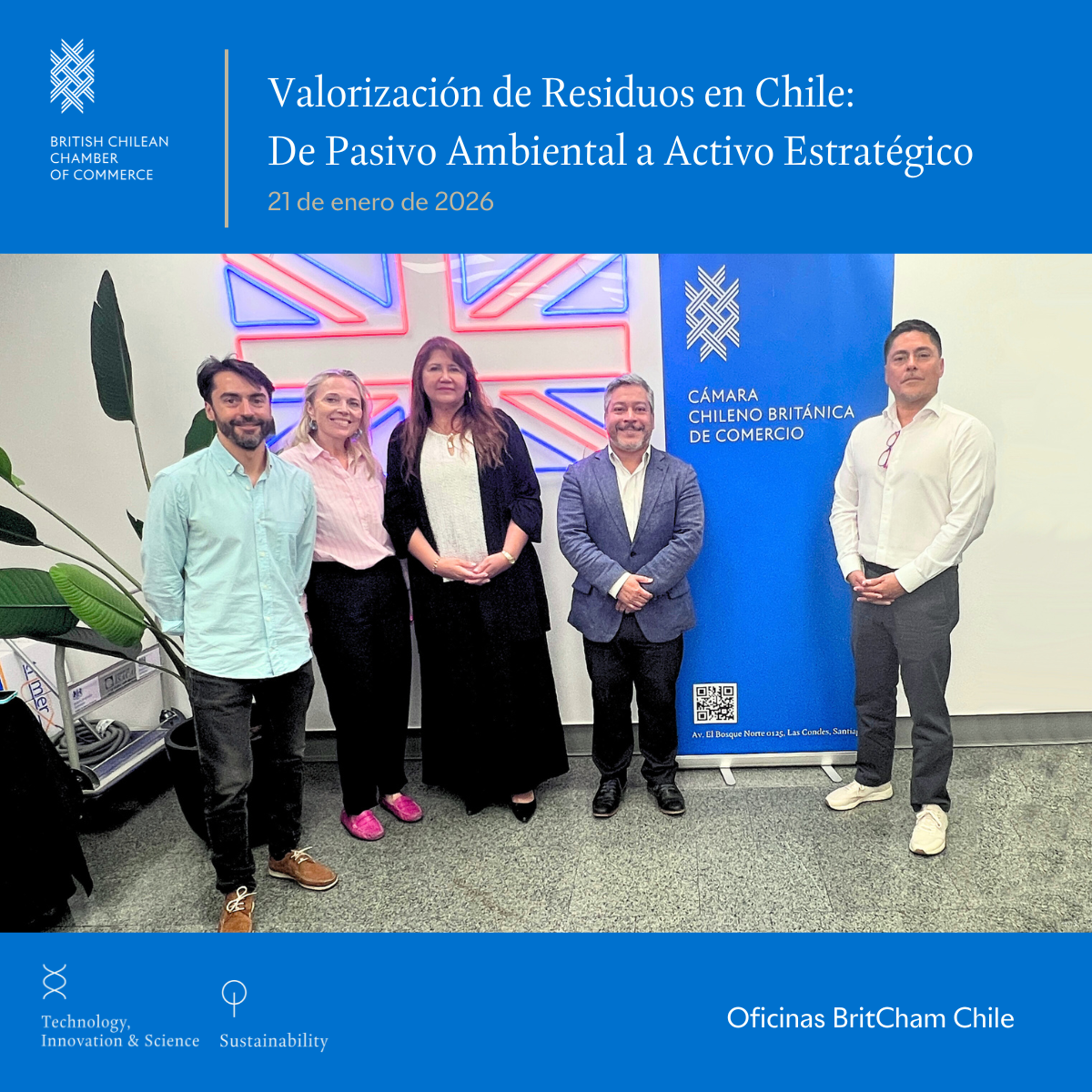
This was the central conclusion of the high-level conversation “Waste Valorisation in Chile: From Environmental Liability to Strategic Asset”, organised by the Technology, Innovation and Sciences Committee and the Sustainability Committee of the British–Chilean Chamber of Commerce (BritCham Chile) and held at BritCham’s offices in Santiago.
The event brought together senior executives, sustainability leaders, legal experts and innovation specialists from sectors including mining, energy, infrastructure, construction and manufacturing, positioning waste valorisation as a core competitiveness issue for Chile’s productive future.
From compliance to value creation
Moderated by Joanna Pérez, President of BritCham’s Technology, Innovation and Sciences Committee, the session moved decisively beyond regulatory compliance and focused on the structural question facing industry:
How can Chile scale waste valorisation into a profitable, investable and technologically viable market?
The discussion highlighted that although Chile has become a regional reference in environmental regulation, regulation alone does not generate markets. Without adequate infrastructure, economic incentives and collaborative models, many valorisation initiatives remain trapped at pilot stage.
“Chile can no longer afford to treat waste solely as a regulatory obligation. Today, waste must be understood as an economic opportunity capable of generating innovation, new business models and investment.”
She highlighted that international experience — particularly from the United Kingdom and Europe — demonstrates that successful circular economies are built through coordinated action between regulation, technology, infrastructure and market incentives.
Speakers and expert perspectives
Guillermo García Moscoso, Partner, GDS Abogados, LL.M. Environmental Law, University College London, Former advisor to the Ministry of the Environment and consultant to the Inter-American Development Bank (IDB) addressed the regulatory evolution of waste management in Chile, explaining how the country has moved from a strictly sanitary approach to a broader environmental logic.
“For decades, regulation treated waste as ‘garbage and disposal’. The REP Law represents a paradigm shift — it is not only about products, but a general framework for waste management.”
He stressed that regulation must not only impose obligations, but also enable investment:
“Norms must evolve from merely prohibiting to actively enabling. When regulation facilitates the use of materials — such as mining slags in infrastructure — it immediately opens investment opportunities that previously did not exist.”
García also highlighted the importance of regulatory certainty for investors:
“Valorisation projects fail not because technology is unavailable, but because uncertainty around permits, classification and responsibility discourages long-term investment.”
Cristian Zegers Cádiz, Senior Consultant in Circular Economy and Sustainability, Leader of Chile’s delegation for ISO 59001 and ISO 59010 Circular Economy Standards focused on the operational and technological dimension, emphasising that Chile already has access to advanced solutions — but lacks scale and coordination.
“The bottleneck is not technology. Chile has digital traceability systems, biomaterials, biorefineries, data platforms and industrial efficiency tools. The real challenge is the business model.”
He underscored the need for cooperation and territorial approaches:
“Valorisation cannot be done company by company. Logistics and volumes require collaboration. Industrial symbiosis is not optional — it is the only way these projects become economically viable.”
Zegers also highlighted the strategic importance of innovation funding:
“Many companies are unaware that Chile has public programmes capable of financing up to 60% of innovation costs. These instruments are designed not only for startups, but for established companies and their suppliers.”
Panelists emphasised that waste management must evolve from a linear disposal logic to a value-chain approach, where materials, data, technology and collaboration become strategic enablers.
Key insights from the panel
🔹 Infrastructure and incentives remain the critical gap
While Chile has advanced rapidly in environmental legislation, speakers agreed that the main barrier is not regulation, but the absence of shared infrastructure and economic incentives. Disposal to landfill remains cheaper than valorisation, creating a structural disincentive for investment.
Experts stressed the need for public–private investment mechanisms, tax incentives and enabling infrastructure to accelerate market maturity — a model successfully implemented in the UK and Europe.
🔹 Waste valorisation is fundamentally a business model challenge
According to the panel, technology is no longer the bottleneck. Chile already has access to solutions in traceability, digital efficiency, biomaterials, biorefineries, industrial symbiosis and data-driven optimisation.
The real challenge lies in designing viable business models, securing sufficient volumes, reducing logistics costs and enabling collaboration between companies operating within the same territorial ecosystems.
🔹 Collaboration reduces risk and unlocks scale
Valorisation projects rarely succeed in isolation. Cooperation among companies — including competitors — allows risks, investment and learning curves to be shared.
Panelists highlighted that Chile’s position within global value chains makes industrial symbiosis not only desirable but inevitable for long-term competitiveness.
🔹 Regulation must evolve from restriction to enablement
From mining residues to construction materials, renewable energy components and emerging technologies, the discussion underscored the importance of regulatory habilitation, simplification of permits and clearer classification of residues.
Recent advances — such as regulatory pathways for mining slags and emerging frameworks for other materials — demonstrate progress, yet participants agreed that greater regulatory agility is essential to attract investment at scale.
🔹 Innovation funding is underused by industry
Chile possesses one of the most developed innovation support ecosystems in Latin America. However, many companies remain unaware that public programmes can finance up to 60% of innovation and technology development costs, including supplier-driven solutions.
This represents a significant opportunity to strengthen supply chains, improve traceability and accelerate adoption of circular solutions without increasing corporate CAPEX.
Strategic relevance for investors and international partners
The conversation reaffirmed that waste valorisation is no longer an environmental side issue. It is increasingly linked to:
Drawing on international experience — particularly from the United Kingdom and the European Union — the panel demonstrated how mature circular economy markets can generate new industrial sectors, attract technology providers and create long-term investment opportunities.
For international investors, Chile offers a compelling combination:
clear regulation, strong institutional frameworks, innovation funding instruments and urgent market demand.
The interactive segment of the event revealed strong engagement from industry representatives, who raised critical issues currently limiting large-scale implementation:
Mining sector
Energy and renewables
Infrastructure and construction
Innovation and entrepreneurship
These questions confirmed a shared diagnosis: Chile’s challenge is no longer conceptual, but systemic.
Strategic conclusions
The discussion converged on several key conclusions:
BritCham Chile’s commitment
Through its Technology, Innovation and Sciences Committee, BritCham Chile reaffirms its role as a bridge between policy, industry, innovation and international best practice.
This event forms part of a broader strategic agenda aimed at:
A follow-up editorial series and future technical sessions will continue deepening this discussion throughout 2026.