
CORFO presents its priorities at BritCham Chile to boost productivity, innovation and growth in its new phase
August 18 ,2026


August 18 ,2026
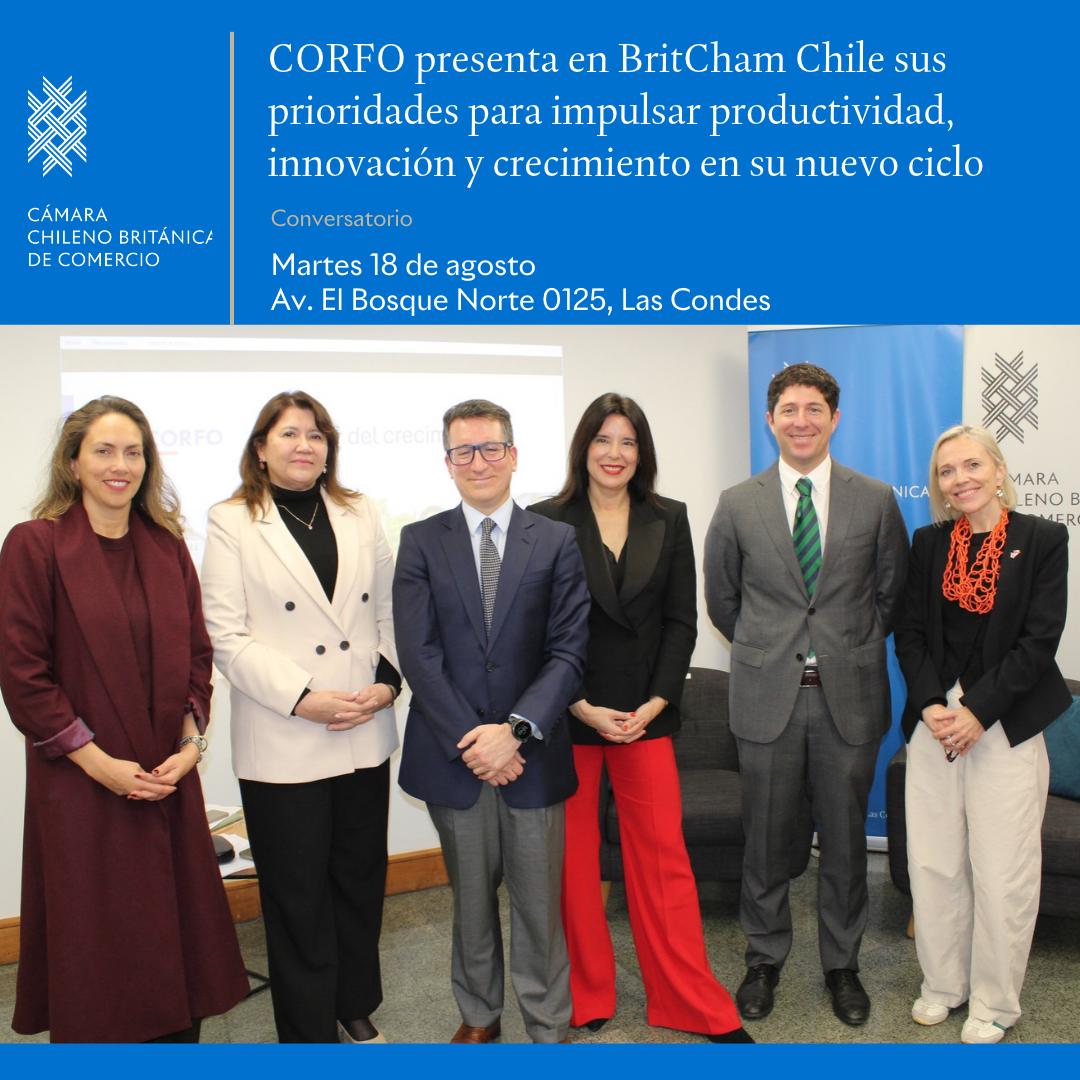
CORFO Executive Vice-President José Ignacio Mujica presented the main priorities that will guide the Corporation’s management to members of the Chilean-British Chamber of Commerce, with a focus on measuring the impact of its instruments, strengthening engagement with businesses, expanding technological capabilities, advancing regional development and harnessing Artificial Intelligence to make the institution more efficient.
Santiago, 18 August 2026. Turning innovation into productivity and tangible growth, strengthening links between the State and businesses, and measuring more accurately the impact generated by public resources will be among the main priorities of the Chilean Economic Development Agency (CORFO) during its new phase.
This was the message delivered by José Ignacio Mujica, Executive Vice-President of CORFO, during the event “Conversation with José Ignacio Mujica: CORFO’s Goals for its New Phase”, organised by the Legal Committee, the Technology, Innovation and Science Committee and the Sustainability Committee of the Chilean-British Chamber of Commerce (BritCham Chile).
The event brought together representatives from companies and different productive sectors to discuss the role CORFO can play in addressing some of Chile’s main structural challenges: productivity, innovation, access to finance, technological development, decentralisation, sustainability and public-private collaboration.
Opening the discussion, Paola Cifuentes, Chair of BritCham Chile’s Legal Committee and Legal Manager at Anglo American in Chile, stressed that innovation, sustainability and regulation must be addressed in an integrated manner if Chile is to make progress on growth and investment.
“Investment and innovation require confidence, and that confidence requires strong institutions, clear rules and certainty. At the same time, however, we live in a world in which technology, business models and the needs of our industries are changing at an extraordinary pace.”
Cifuentes also emphasised that Chile has resources, knowledge, talent and world-class industries, but that the challenge lies in transforming these advantages into innovation, technology, new suppliers, greater productivity and exportable capabilities. Achieving this, she said, requires deeper collaboration between the public sector, businesses, entrepreneurs, academia and regulators.
During his presentation, Mujica argued that CORFO must maintain a long-term vision and preserve the continuity of public policies that require several years to deliver results. However, he identified as one of the key changes in this new phase the need to move beyond measuring instruments and beneficiaries towards a deeper assessment of the results they generate.
“We know that we provide support to thousands and thousands of people, but sometimes it is difficult to determine what that actually generates. It is difficult to know whether a company, after participating in a CORFO programme, grew, created more jobs or generated greater value. That is something we are certainly working on.”
In this area, he explained that CORFO is strengthening its internal data analysis capabilities and beginning to make more intensive use of Artificial Intelligence tools.
The objective, he said, is to make the impact of public resources more visible and to build an evidence base that can support better decision-making.
“We manage public resources, and part of validating the role of what we do is providing information and explaining what we are achieving. We have the data; what we need now is to start making better use of it.”
One of the main priorities outlined by Mujica is to build a CORFO that is more closely connected to the specific needs of businesses and productive sectors.
He explained that the Corporation already works simultaneously with large companies, suppliers, entrepreneurs and innovative businesses. The next step is to use this position to facilitate connections that enable innovations to reach the market effectively.
“If I know a large mining company and, at the same time, I am supporting hundreds of companies that supply the mining industry, we can take an additional step and ask how we can connect them more effectively. That is a genuine and significant change.”
For Mujica, one of the major challenges is to prevent innovation from ending with a good idea or a pilot project.
“The possibility of increasing productivity and ensuring that innovation does not remain merely a good idea, but translates into a tangible benefit and a growing company, is based precisely on that connection.”
This closer engagement with the productive sector also involves reducing barriers to accessing CORFO instruments, particularly for smaller companies and regional entrepreneurs.
“We need to simplify, communicate and be present. We need to ensure that people know what is available and, ideally, are able to use it.”
A central component of the strategy is the network of technology centres supported by CORFO, which provide infrastructure enabling companies and entrepreneurs to conduct tests, develop prototypes, pilot solutions and progress towards scale-up.
Mujica highlighted that this ecosystem encompasses areas including mining, biotechnology, the circular economy, industrialised construction, healthcare, creative industries and Artificial Intelligence.
Among the initiatives mentioned was the development of new supercomputing centres in Santiago and Valparaíso, which will give companies and innovators access to infrastructure for testing Artificial Intelligence models and applications that would otherwise be difficult for them to finance independently.
“This entire network of centres represents a unique opportunity for Chile, and we have to make use of it.”
Artificial Intelligence featured prominently in the discussion. Joanna Pérez, Chair of BritCham Chile’s Technology, Innovation and Science Committee, argued that Chile’s challenge goes beyond incorporating new tools and requires the country to define strategically where it wants to position itself in a global competition increasingly shaped by technology, productivity and innovation.
“Globally, we are all competing to achieve greater productivity and use technology to become more competitive. The key question is where Chile wants to position itself: whether we want to be developers of technology or a country capable of adopting it and using it across our different sectors.”
Pérez referred both to major technology-developing economies, such as the United States and China, and to smaller countries that have successfully positioned themselves through rapid and effective technology adoption. Against this backdrop, she also highlighted the challenge of capitalising on Chile’s comparative advantages to generate innovation capable of scaling from strategic sectors such as mining.
Responding to this point, Mujica explained that CORFO is already seeing significant growth in the number of ventures incorporating AI into their products, services and business models, and indicated that its instruments could introduce incentives to encourage greater technology adoption.
He also noted that the Corporation is participating in larger-scale initiatives aimed at introducing Artificial Intelligence into productive and social sectors.
In healthcare, for example, CORFO is participating in projects using AI for early disease detection and reducing waiting lists, through consortia bringing together universities, companies, healthcare providers and technology suppliers.
“We are launching instruments to introduce Artificial Intelligence into traditional sectors. This could be mining, agribusiness or forestry. These are significant financing initiatives specifically linked to Artificial Intelligence.”
This is complemented by the development of technological infrastructure, including the planned supercomputing centres in Santiago and Valparaíso, and coordinated work with the Ministries of Science, Economy and Finance to contribute to public policy capable of responding to a technology that is evolving rapidly.
Mujica also addressed CORFO’s role as a financing instrument, explaining that the Corporation will continue to participate in venture capital and support investment funds, while also seeking to strengthen financing channelled through banks and non-bank financial institutions.
According to Mujica, more than US$1.6 billion in loans were generated using CORFO guarantees over the past year.
The potential, he argued, is considerably greater.
“Given CORFO’s capital base, that could be doubled. We could be generating more than US$3 billion in credit through banks using our guarantees.”
The priority will be to deploy these mechanisms where they can deliver greater additionality, improved access, better financing conditions and broader coverage, including in the regions and in activities linked to the productive and energy transitions.
Areas mentioned included electromobility, renewable energy and sustainable infrastructure projects.
Asked about the opportunities facing Chile’s mining industry, Mujica identified two particularly significant challenges: stagnant productivity and the need to develop suppliers capable of scaling and exporting.
Compared with mining ecosystems such as Australia and Canada, he noted, Chile still has considerable scope to increase the internationalisation of its suppliers.
There is also an internal barrier: many innovations fail to move from specialised innovation teams into companies’ core operations.
“The challenge is for innovation initiatives to move beyond the innovation department. As long as they remain there and do not reach the core business and operations management, it will be difficult to break through that barrier.”
Mujica highlighted that some companies have already incorporated innovation with tangible results and argued that one of CORFO’s roles should be to make these success stories more visible in order to accelerate adoption by other companies and sectors.
Regarding R&D, he also noted that approximately CLP 26 billion in tax benefits were granted under the R&D Tax Incentive Law over the past year, with mining accounting for approximately half of the total.
“The mining industry is making active use of this. We need it to translate somewhat more into results, but we have a strong foundation.”
Another pillar of the new phase will be to strengthen the model of Regional Productive Development Committees, which bring together CORFO, regional governments and other development agencies to define instruments and allocate resources according to the productive priorities of each territory.
Mujica highlighted that regional governments have begun transferring resources to these mechanisms, which he described as a tangible indication of confidence in the model.
“The fact that regional governments are transferring resources to these committees for allocation is, I believe, the clearest sign that there is confidence and that things are being done well. This is something we will continue to promote over the next four years.”
He explained that the committees have a significant degree of autonomy to adapt their priorities to the economic and productive needs of each region.
Speaking from the perspective of the Sustainability Committee, its Chair, Laura Landeta, raised the question of how sustainability is being incorporated into CORFO’s new strategic direction and the design of its instruments.
Mujica said that sustainability is now embedded in CORFO’s activities, even if it is not necessarily made explicit in every programme.
“Sustainability is already at the core of CORFO. If today we are communicating more about concepts such as business engagement, impact and coordination between ministries, it is because sustainability is already deeply embedded within the institution.”
At the same time, he highlighted the need to strike an appropriate balance in the design of instruments so that sustainability, gender and other public policy priorities do not result in requirements that unnecessarily hinder investment or reduce participation.
Throughout the discussion, a recurring theme was the need for stronger coordination between CORFO, businesses, ministries, regional governments, universities and other public institutions.
Mujica cited industrialised construction as an example: CORFO can support technologies, suppliers and new productive models, but their impact can be multiplied considerably through closer coordination with the Ministry of Housing.
A similar logic, he explained, applies to healthcare, mining, Artificial Intelligence and other areas.
The approach involves strengthening CORFO’s role as a facilitator and connector of capabilities, in addition to its role as a source of financing.
“We are convinced that the more closely connected we are with other public services and ministries, the greater the impact our initiatives will have.”
Finally, Mujica addressed CORFO’s internal challenges. The organisation has a workforce of approximately 1,000 people, around 350 of whom are based in the regions.
Management priorities include moving towards a more horizontal and agile structure, reducing siloed working practices and making better use of the accumulated expertise of teams with extensive experience within the institution.
Digital transformation and Artificial Intelligence will form part of this process.
“Our focus is to enable our executives and teams to spend less time on administrative work and more time focused on the business itself.”
He added that the same principle should apply to those using CORFO’s instruments, by reducing processing times and simplifying procedures.
The conversation at BritCham Chile provided a comprehensive overview of CORFO’s new phase, bringing together growth, productivity, innovation, financing, technology, sustainability, regional development and institutional capacity, with a central focus on translating public-sector instruments into tangible results for businesses, Chile’s regions and the country’s economic development.


