
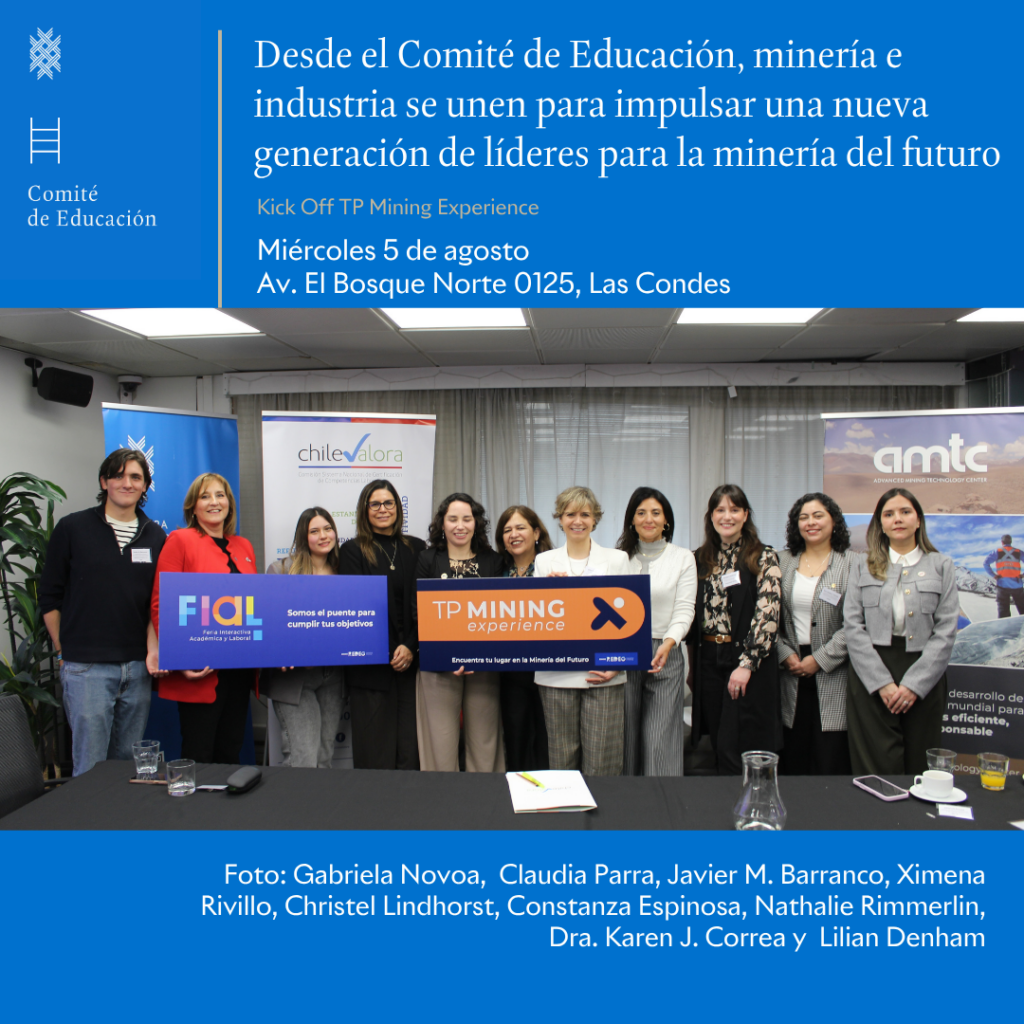
El lanzamiento de TP Mining Experience reunió en la Embajada Británica a representantes de Anglo American, Universidad de Chile, Pontificia Universidad Católica de Valparaíso, ChileValora, Compromiso Minero y otras organizaciones para fortalecer la empleabilidad, el liderazgo y la vinculación entre educación superior e industria minera.
Santiago, 5 de agosto de 2026. Con el propósito de acercar a las nuevas generaciones a los desafíos de la minería del futuro, la Cámara Chileno Británica de Comercio (BritCham Chile), a través de su Comité de Educación, fue anfitriona del lanzamiento de TP Mining Experience, una iniciativa desarrollada por REDEG Consulting & Training junto a un amplio ecosistema de instituciones públicas, académicas y empresariales, que busca fortalecer la empleabilidad, el liderazgo y las competencias técnico-humanas de estudiantes que próximamente ingresarán a la industria minera.
Realizado en las oficinas de la Embajada Británica en Santiago, el encuentro reunió a representantes de Anglo American, Advanced Mining Technology Center (AMTC) de la Universidad de Chile, ChileValora, Compromiso Minero, Instituto de Ingenieros de Minas de Chile, Red de Ingenieras de Mina (RIM), Universidad Andrés Bello, el Centro de Estudiantes Mineros (CEM) y el Comité de Educación de BritCham Chile, quienes coincidieron en que el futuro de la minería dependerá tanto de la excelencia técnica como de la capacidad de liderazgo, adaptación, colaboración y aprendizaje continuo.
Durante la apertura, Lilian Denham, directora ejecutiva de REDEG Consulting & Training, presentó los objetivos de TP Mining Experience, un programa que busca crear una red efectiva entre estudiantes, universidades y empresas para reducir las brechas entre la formación académica y las necesidades reales de la industria. La iniciativa considera encuentros periódicos, mentorías, networking, certificación de competencias y un programa práctico para desarrollar proyectos mineros desde su concepción hasta su evaluación técnica.
La conferencia principal estuvo a cargo de Carmen Duarte, Culture and Change Lead de Anglo American, quien sostuvo que la industria minera está atravesando una transformación sin precedentes impulsada por la transición energética, la digitalización, la automatización y el recambio generacional.
\”La minería del futuro se está construyendo hoy con cobre, tecnología y diversidad. Pero será liderada por personas capaces de movilizar a otras personas en medio del cambio. El desafío es contar con líderes con el expertise técnico suficiente que sean capaces de adaptarse, colaborar y asumir la responsabilidad de que el cambio parte con ellos\”, afirmó.
Duarte explicó que la industria demandará más de 34.000 nuevos trabajadores hacia 2032, impulsada por nuevos proyectos, ampliaciones de capacidad y el reemplazo de una fuerza laboral que envejece, escenario que convierte al desarrollo del talento joven en un desafío estratégico para el país. Asimismo, destacó que Chile lidera actualmente la participación femenina en la minería a nivel mundial y que las nuevas generaciones deberán desenvolverse en entornos altamente tecnológicos y colaborativos.
Uno de los ejes centrales del conversatorio fue la estrecha relación entre educación superior e innovación.
Gabriela Novoa, directora de Relaciones Estratégicas, Diversidad y Equidad de Género del Advanced Mining Technology Center (AMTC) de la Universidad de Chile, destacó la importancia de conectar la investigación aplicada con las necesidades de la industria.
\”Hemos comprobado que cuando los estudiantes participan directamente en proyectos reales de investigación aplicada junto a la industria, se generan nuevas oportunidades de innovación y también de inserción laboral. Hoy el talento científico también debe formar parte de la minería\”, señaló.
Desde BritCham Chile, Claudia Parra, presidenta del Comité de Educación y directora del Programa de Inglés de la Pontificia Universidad Católica de Valparaíso, enfatizó que el dominio del idioma inglés dejó de ser una competencia adicional para transformarse en una herramienta esencial para el desarrollo profesional.
\”El inglés potencia todo desarrollo profesional. Hoy la minería trabaja en redes globales, utiliza tecnologías desarrolladas internacionalmente y requiere profesionales capaces de comunicar con precisión y participar en proyectos internacionales. El idioma abre oportunidades para el desarrollo económico del país\”, afirmó.
Por su parte, Javier Barranco, representante del Centro de Estudiantes Mineros (CEM), destacó que la formación de los futuros profesionales debe ir mucho más allá del conocimiento técnico.
\”Queremos que los estudiantes comprendan para qué hacemos minería, para quiénes y bajo qué principios queremos desarrollarla. Ese entendimiento superior de la minería es parte del liderazgo que necesita la industria\”, indicó.
La importancia de reconocer las competencias adquiridas tanto dentro como fuera de la educación formal fue abordada por Ximena Rivillo, directora ejecutiva de ChileValora, quien explicó que el país necesita avanzar hacia un modelo de aprendizaje permanente.
\”El mundo de la educación y el mundo del trabajo deben conversar mucho más. Reconocer las competencias laborales permite mejorar la empleabilidad, fortalecer la productividad y facilitar trayectorias formativas continuas durante toda la vida\”, señaló.
En tanto, Christel Lindhorst, directora ejecutiva de Compromiso Minero y gerente de Comunicaciones del Consejo Minero, destacó la necesidad de acercar la industria a las nuevas generaciones mediante una comunicación más efectiva.
\”Si no somos capaces de comunicar lo que hace hoy la minería, será muy difícil que los jóvenes la vean como una oportunidad para desarrollar su proyecto profesional. La minería ofrece enormes posibilidades para quienes buscan generar impacto y aportar al desarrollo sostenible del país\”, sostuvo.
Constanza Espinosa, gerenta general del Instituto de Ingenieros de Minas de Chile (IIMCh), destacó que el desarrollo del talento no termina con la obtención del título profesional, sino que requiere una actualización permanente para responder a una industria que evoluciona con rapidez.
\”Hoy la minería demanda profesionales capaces de aprender de manera continua y de responder con agilidad a los cambios científicos, tecnológicos y de gestión. Fortalecer las redes entre la academia, la industria y las organizaciones técnicas es fundamental para acelerar ese proceso y mantener la competitividad del sector\”, señaló. Esta visión está alineada con el rol que el Instituto busca consolidar como articulador del conocimiento y del desarrollo del capital humano para la minería del futuro.
Por su parte, Nathalie Rimmerlin, presidenta de la Red de Ingenieras de Mina (RIM), sostuvo que el futuro de la minería exige construir ambientes de trabajo más diversos, colaborativos e inclusivos desde la formación universitaria.
\”La diversidad no puede comenzar cuando los profesionales ingresan a una empresa. Debe construirse desde la etapa de formación, generando redes, referentes y oportunidades que permitan desarrollar liderazgos diversos capaces de responder a los desafíos tecnológicos y sociales que enfrenta la minería\”, afirmó durante el conversatorio, enfatizando que las nuevas generaciones deberán desenvolverse en equipos multidisciplinarios y altamente colaborativos.
Finalmente, la Dra. Karen J. Correa, directora de la Escuela de Ciencias de la Tierra y de la carrera de Geología de la Universidad Andrés Bello, destacó que la formación de los futuros profesionales debe integrar conocimientos científicos con habilidades personales y conductuales.
\”Las competencias técnicas son indispensables, pero hoy la industria también busca profesionales que se conozcan, asuman responsabilidades, trabajen colaborativamente y sean capaces de adaptarse a escenarios complejos. Ese liderazgo comienza a desarrollarse durante la formación universitaria\”, indicó, reforzando la necesidad de preparar especialistas capaces de aportar al desarrollo sostenible de la minería chilena.
Con estas incorporaciones, el comunicado recoge la participación de los nueve representantes que integraron el panel de lanzamiento de TP Mining Experience, reflejando de manera equilibrada la contribución del mundo empresarial, la academia, las organizaciones profesionales y el sector público.
El encuentro concluyó con la firma simbólica del manifiesto \”Conecta y Emplea: Más y mejores oportunidades para Chile\”, que promueve un modelo colaborativo de empleabilidad e inserción laboral basado en la articulación entre empresas, instituciones de educación superior, organismos públicos y organizaciones especializadas, consolidando una red destinada a preparar a la próxima generación de profesionales que liderará la transformación de la minería chilena.
Galería de imágenes