
Santiago, 8 de julio de 2026. La implementación de la Ley N° 21.778, que establece la incorporación progresiva de al menos 60 minutos diarios de actividad física, deporte o juego en los establecimientos educacionales del país en una primera parte hasta el 2027, representa una de las transformaciones más relevantes que ha experimentado el sistema escolar chileno en materia de bienestar y desarrollo integral. Sin embargo, para que esta política pública alcance su verdadero impacto, será indispensable avanzar desde el cumplimiento normativo hacia una transformación pedagógica que sitúe el movimiento como parte esencial del aprendizaje.
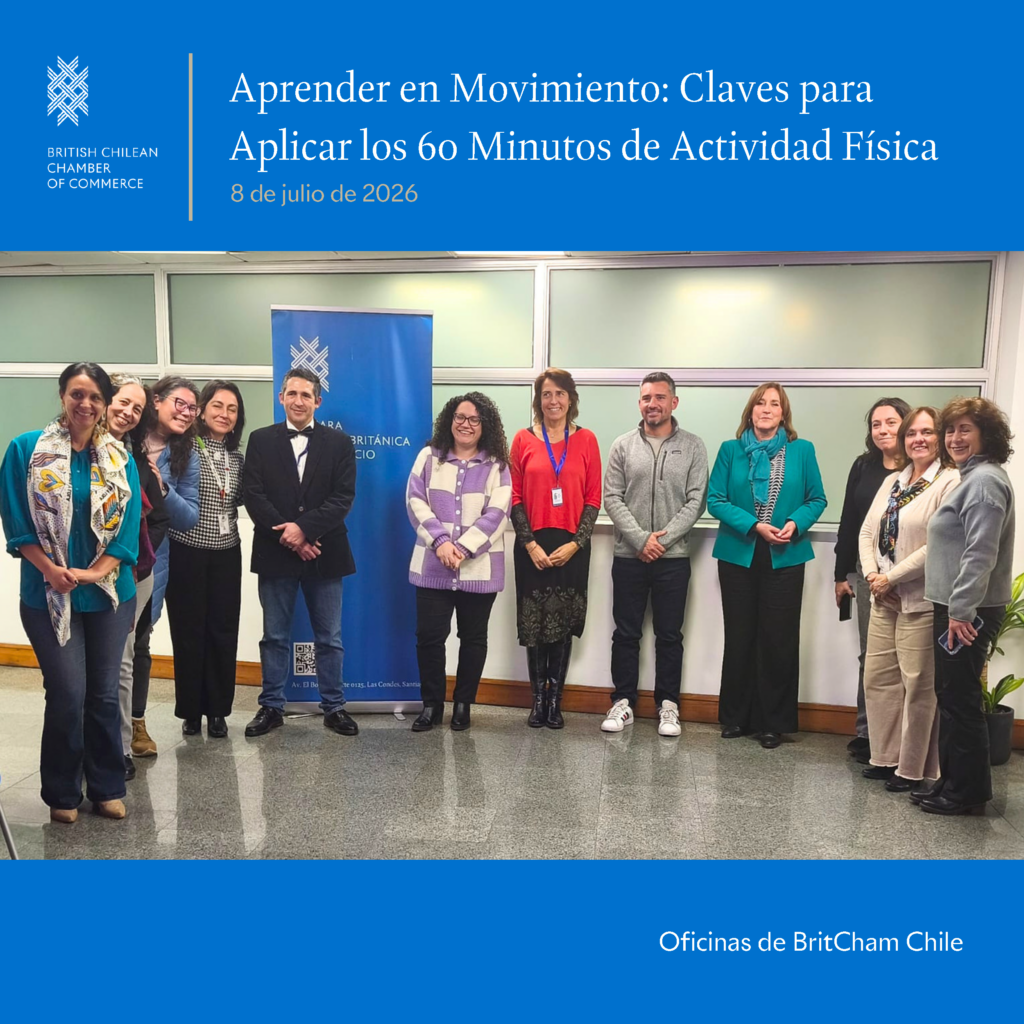
Con ese propósito, el Comité de Educación de BritCham Chile realizó el conversatorio \”Más Movimiento, Más Aprendizaje: Implementando la Ley de los 60 Minutos en el Mundo Escolar Chileno\”, instancia que reunió a representantes de establecimientos educacionales, universidades, fundaciones y especialistas para analizar los desafíos y oportunidades que plantea esta nueva legislación.
La actividad fue moderada por Claudia Parra Böhringer, presidenta del Comité de Educación de BritCham Chile y Directora del Programa de Inglés de la Pontificia Universidad Católica de Valparaíso, y contó con la presentación principal de Karin Haddad, Coordinadora de la mención en el Magíster en Educación de la Universidad Finis Terrae y especialista en Psicomotricidad Educativa, presentada por Kolaborativa Educa.
Entre los asistentes participaron representantes de instituciones como Universidad de Chile, Fundación Anglo American, Cognita Chile, Richmond Santillana, Trewhela\’s School, Instituto Alonso de Ercilla, Orchard College, SLEP Santiago Centro, Compañía de María Seminario, Colegio Coyancura, Colegio Andrés Bello y diversos establecimientos educacionales y organizaciones vinculadas al desarrollo escolar.
Durante su exposición, Karin Haddad destacó que la aprobación de la ley constituye un avance significativo para enfrentar el sedentarismo infantil, pero advirtió que su éxito dependerá de la calidad de su implementación.
\”La gran pregunta ya no es si tendremos 60 minutos de movimiento, sino cómo aseguramos que esos 60 minutos generen aprendizaje, inclusión y bienestar, y no se transformen simplemente en tiempo que cumplir\”, señaló.
La especialista explicó que la evidencia científica demuestra que el movimiento favorece la neurogénesis, mejora la oxigenación cerebral y fortalece procesos como la atención, la memoria, la concentración y la autorregulación emocional, elementos directamente relacionados con el rendimiento académico. Asimismo, subrayó que la actividad física también contribuye a mejorar la convivencia escolar y el bienestar socioemocional de estudiantes y docentes.

Uno de los mensajes centrales del encuentro fue que la implementación de la ley no debe entenderse como una responsabilidad exclusiva de los profesores de Educación Física.
Por el contrario, los participantes coincidieron en que el movimiento debe incorporarse de manera transversal a la experiencia educativa mediante metodologías activas, adecuaciones de los espacios escolares, pausas activas, recreos dinámicos y estrategias pedagógicas que permitan aprender desde la corporeidad.
Durante el diálogo también se destacó que la normativa contempla una implementación gradual con una primera parte hasta el 2027, lo que convierte a 2026 en un período clave para que los establecimientos educacionales desarrollen diagnósticos, pilotajes y procesos de preparación institucional.
En este contexto, varios participantes coincidieron en que la autonomía de cada establecimiento será fundamental para diseñar modelos acordes con su realidad educativa, evitando enfoques uniformes que desconozcan las distintas capacidades y contextos escolares.
Asimismo, se recordó que el artículo 5 de la Ley contempla procesos de capacitación, aunque no establece quién será responsable de impartir dicha formación. Esto abre una oportunidad para que universidades, instituciones de educación superior y organizaciones especializadas desarrollen programas que apoyen a los establecimientos en la preparación de sus equipos docentes.
En esa línea, Karin Haddad planteó que la formación continua será uno de los factores más determinantes para el éxito de la implementación.
\”Más que improvisar actividades, debemos diseñar experiencias de aprendizaje basadas en evidencia. No existe una receta única para implementar la ley, pero sí debe existir un estándar mínimo de conocimiento sobre el impacto cognitivo, socioemocional y pedagógico del movimiento\”, afirmó.
Entre las alternativas analizadas surgió la posibilidad de que las instituciones de educación superior incorporen asignaturas optativas y electivas orientadas específicamente a la aplicación de la ley en los procesos formativos de futuros docentes, junto con fortalecer programas de educación continua dirigidos a profesionales que actualmente se desempeñan en el sistema escolar.
Los asistentes coincidieron en que estas iniciativas permitirían responder con mayor rapidez a los desafíos que impone la nueva normativa, mientras los procesos de actualización curricular avanzan en los tiempos propios de las instituciones formadoras.

Otro de los aspectos destacados durante el conversatorio fue el rol estratégico que deberán asumir los equipos directivos.
Los participantes señalaron que serán los directores quienes tendrán la posibilidad de convertir esta obligación legal en un sello institucional, integrando las acciones relacionadas con la actividad física dentro de los instrumentos de gestión escolar que posteriormente serán objeto de seguimiento y evaluación.
La conversación también abordó la necesidad de comprender el movimiento como un componente del bienestar integral y no únicamente como una actividad deportiva.
En este sentido, se analizaron experiencias nacionales e internacionales que muestran cómo pequeños cambios en las rutinas escolares —como recreos activos, aulas más flexibles, metodologías participativas y ambientes que favorezcan el desplazamiento— pueden generar mejoras significativas tanto en el aprendizaje como en la convivencia escolar.
El encuentro concluyó con un amplio consenso respecto de que la Ley de los 60 Minutos representa una oportunidad para repensar la educación desde una perspectiva más integral, donde el desarrollo cognitivo, físico, emocional y social formen parte de un mismo proceso educativo.
Más allá del cumplimiento de una obligación normativa, los participantes coincidieron en que el verdadero desafío será construir una cultura escolar donde el movimiento deje de ser un elemento accesorio y pase a constituirse en una herramienta permanente para favorecer el aprendizaje, la inclusión y el bienestar de toda la comunidad educativa.
Como señaló Karin Haddad al cierre de la jornada:
\”Nos tenemos que mover para poder ver cambios en el bienestar de nuestra sociedad. Enseñar también es enseñar a habitar el cuerpo, y cuando incorporamos el movimiento al aprendizaje, estamos formando personas más saludables, más felices y mejor preparadas para aprender\”.
Galería de imágenes
Ley 60 minutos activos